
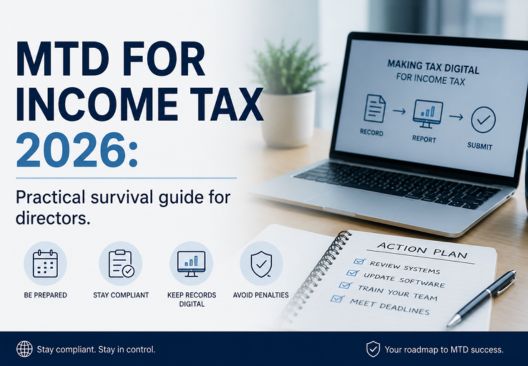
MTD for Income Tax 2026 Explained for Limited Company Directors
Starting 6 April 2026, the way tax is reported in the UK has fundamentally changed. If you are a limited company director who also earns income from property or self-employment, you are likely now entering the "MTD era."
But there is a lot of noise out there. This guide skips the jargon and gives you the exact roadmap you need to stay compliant, avoid penalties, and keep your focus on running your business.
1. Does MTD 2026 Apply to You?
The biggest question we get is: "Does my Limited Company have to follow MTD?"
The Short Answer: No. MTD for Corporation Tax has been postponed indefinitely. Your company continues to file its CT600 as usual.
The Reality for Directors: While your company is safe, you personally might not be. MTD for Income Tax (ITSA) applies to individuals with qualifying income over £50,000.
What counts as "Qualifying Income"?
-
✅ Rental Income: Gross rent from UK or overseas property (before expenses).
-
✅ Self-Employment: Turnover from any sole trader side-hustle.
-
❌ Exclusions: Director salaries (PAYE), dividends, and bank interest do not count toward the MTD threshold.
Scenario: If you draw a £12,570 salary and £40,000 in dividends, you are not in scope. However, if you also receive £55,000 in gross rent from a buy-to-let, you must comply with MTD from April 2026.
2. The 2026–2028 Rollout Timeline
HMRC is phasing this in. Mark these dates in your calendar:
-
April 2026: Mandatory for those with qualifying income over £50,000.
-
April 2027: The threshold drops to £30,000.
-
April 2028: The threshold is expected to drop to £20,000.
3. The New "Quarterly" Rhythm
The days of the "January 31st panic" are over. MTD replaces the single annual Self-Assessment return with a five-part reporting cycle:
-
Four Quarterly Updates: A digital summary of your income and expenses sent to HMRC every three months.
-
A Final Declaration: This replaces the old tax return, where you confirm your final figures and claim reliefs.
2026/27 Deadlines to Watch:
-
Quarter 1 (Apr-July): Due 7 August 2026
-
Quarter 2 (July-Oct): Due 7 November 2026
-
Quarter 3 (Oct-Jan): Due 7 February 2027
-
Quarter 4 (Jan-Apr): Due 7 May 2027
4. Solving the "Software Problem"
You cannot submit MTD updates through the HMRC website manually. You must use HMRC-compatible software.
At TaxVatReturn, we are Platinum Partners with the UK’s leading platforms. Here is our expert take:
-
For Contractors: FreeAgent is often included free with business bank accounts and handles simple bookkeeping brilliantly.
-
For Property Portfolios: Xero offers robust tracking for multiple properties.
-
For High-Efficiency: Nomi is our choice for directors who want deep automation and seamless accountant collaboration.
5. The New Penalty System: Don't Get Caught
HMRC has moved to a points-based penalty system.
-
Miss a quarterly deadline? You get 1 point.
-
Once you hit 4 points, you receive an automatic £200 fine.
-
Every subsequent late submission is another £200.
6. Your "Survival" Checklist
To ensure your transition is seamless, follow these three steps today:
-
Calculate your 2024/25 Gross Income: This year's return determines if you must start MTD in 2026.
-
Digitize your receipts: Stop using paper. Start using apps like Dext or Hubdoc to feed data into your accounting software.
-
Bridge the gap: If you aren't already using cloud software, move your records now so you have a clean "trial run" before the deadlines hit.
Expert Advice from TAXVAT
MTD isn't just about "more paperwork"—it’s about better visibility. By seeing your tax liability update every three months, you can plan your cash flow more effectively than ever before.
Need a professional to handle your MTD transition?
Email: info@taxvatreturn.co.uk
Call: 01284 332375
Recent Article